
Lawyer Ken Kuranchie opens up on seeking a third term for Mahama in court

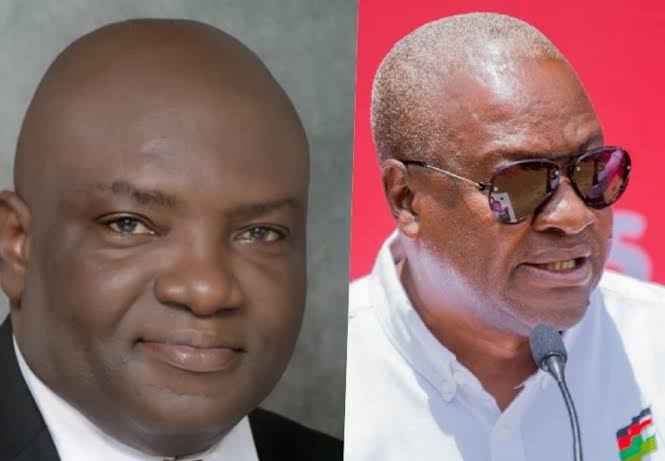
Private legal practitioner Ken Kuranchie has rejected claims that a case he is pursuing at the Supreme Court is intended to help President John Mahama secure a third term in office.
Mr Kuranchie explained that the case is not about giving the President an extra term. Instead, he said the main purpose of the case is to ask the Supreme Court to explain how certain parts of Ghana’s 1992 Constitution should be understood.
According to him, the case focuses on the meaning of presidential terms and whether the terms must always be served consecutively.
Mr Kuranchie made the comments during an interview on Joy News’ PM Express on Monday.
Case Seeks Clarity on Presidential Terms
Mr Kuranchie said his legal action is based on the argument that a person who is elected as President can serve two terms in office.
However, he said there is a question about what happens when a President serves only one term and later leaves office.
According to his argument, if a person leaves the presidency after serving only one term, that person’s eligibility to contest for the presidency should be considered again.
He believes the Constitution needs to be properly interpreted to determine how the rules on presidential terms should apply in such a situation.
Explaining his position, Mr Kuranchie said:
“We are in the Supreme Court asking for what we believe is one of the most important political issues in our democracy.
“Whether the presidency is consecutive or not, if it is consecutive, then what it says clearly is that the person related to the office of president shall serve two terms, or shall serve for two terms,” he said.
Kuranchie Says Case Is About the Constitution
Mr Kuranchie stressed that his case should not be seen as a political move aimed at helping President John Mahama.
Instead, he said the case is about understanding the Constitution and determining exactly what it says about the number of terms a President can serve.
He argued that Ghana’s 1992 Constitution should be read and understood as one complete document.
According to him, it would not be correct to look at only one part of the Constitution when dealing with an important question about presidential elections and terms in office.
Lawyer Calls Constitution a “Generous” Document
Mr Kuranchie described the 1992 Constitution as a large and detailed document that contains many different provisions.
He said the meaning of one provision may need to be considered together with other parts of the Constitution to fully understand the issue.
“The 1992 Constitution is a document that is too generous. It is a big document, and it is to be read as a whole,” he said.
His argument is that the Supreme Court should consider the Constitution as a whole rather than focusing only on one particular article.
He believes doing so will help the court reach a clearer understanding of the rules concerning presidential terms.
Case Relies on Several Parts of the Constitution
Mr Kuranchie also explained that his case is not based only on one article of the 1992 Constitution.
He said his legal team has relied on other provisions and sections of the Constitution in making its argument before the Supreme Court.
“That is why we are not depending on, unlike the other petitioner, we are not depending on Article 662 alone. We have worked in other provisions of the other articles and parts of the 1982 Constitution, like Article 264, 26462, and all that.
He said these other constitutional provisions are important to the argument being presented before the Supreme Court.
Debate Over Presidential Terms
The case has brought renewed attention to the question of presidential term limits in Ghana.
Under Ghana’s constitutional system, a President is elected for a four-year term and can serve a maximum of two terms. However, questions about how those terms should be counted in different circumstances can lead to legal debates and calls for constitutional interpretation.
Mr Kuranchie’s case seeks to have the Supreme Court provide clarity on the issue.
His position is that the matter should be treated as a constitutional question rather than a political campaign to secure another term for President Mahama.
Supreme Court to Consider the Legal Arguments
The Supreme Court will ultimately determine how the relevant provisions of the Constitution should be interpreted.
The court’s decision could provide further clarity on how presidential terms are counted and how the constitutional rules should apply to a person who has previously served as President.
For Mr Kuranchie, the central issue is the proper interpretation of Ghana’s Constitution.
He maintains that his legal action is not designed to secure a third term for President John Mahama but is instead an attempt to obtain a clear interpretation of the country’s supreme law.
The case is therefore expected to remain a subject of public and political discussion as the Supreme Court considers the legal arguments surrounding presidential terms and constitutional eligibility.


One Comment