
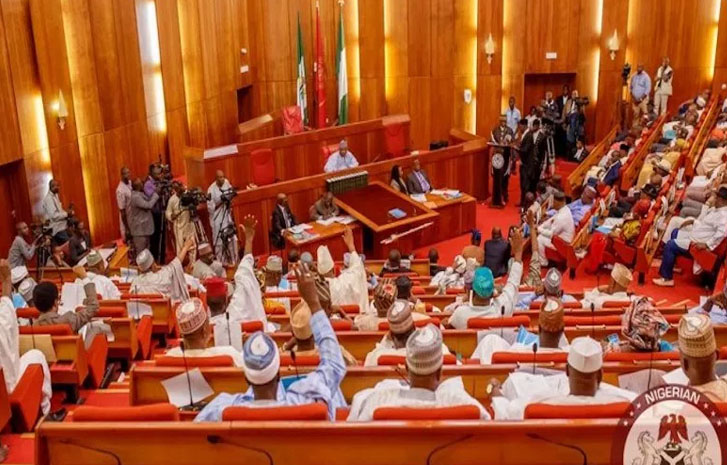
The Nigerian Senate has explained that the ongoing amendment to the Federal Road Safety Commission (FRSC) Act does not introduce a new ban on preaching or hawking.
The Senate said the amendment only repeats rules that already exist concerning activities carried out inside commercial vehicles.
The clarification comes after concerns were raised by members of the public over reports that the proposed amendment would ban preaching and hawking.
In a statement released on Monday by the Directorate of Media and Public Affairs, Office of the Leader of the Senate, the chamber said it was aware of the public concerns surrounding the issue.
The Senate explained that the rules being discussed are not new and have been part of Nigeria’s road traffic laws for many years.
Existing Law Already Covers Preaching and Hawking
According to the Senate, Section 10(4) of the FRSC (Establishment) Act, 2007, already deals with preaching and hawking in commercial vehicles.
The chamber also pointed to Regulation 220 of the National Road Traffic Regulations, 2012.
The Senate said these existing laws already make preaching and hawking inside commercial vehicles offences.
This means that the current amendment is not creating a completely new rule that did not exist before.
Instead, the Senate said the amendment simply carries forward the existing provision into the updated legislation.
The chamber explained that the provision was originally included as Item 36 in the Second Schedule to the 2007 FRSC Act.
According to the Senate, the provision has therefore been part of the law for nearly two decades.
Provision Now Listed as Item 49
Under the current amendment being considered, the same provision has been moved and is now listed as Item 49 in the Second Schedule.
The Senate stressed that the change in the numbering does not mean that a new ban has been introduced.
The chamber said the provision is simply being restated as part of the ongoing amendment process.
The clarification was made to address concerns from members of the public who may have believed that the amendment was introducing a new law against preaching in public places.
Senate Says Street Preaching Is Not Being Banned
The Senate also strongly rejected claims that the amendment would outlaw street preaching.
The chamber said the proposed amendment is focused on safety and is not aimed at stopping religious activities in public spaces.
“It is about the safety of commuters and other road users and is not intended to undermine any religious activity in the public space,” the statement said.
The Senate’s explanation suggests that the provision is specifically concerned with activities inside commercial vehicles and not with religious activities carried out in public spaces generally.
The chamber said the purpose of the provision is to protect commuters and other people who use the roads.
Why the Rule Is Being Discussed
The issue has attracted public attention because of concerns about how the proposed amendment could affect activities such as preaching and hawking.
Preaching and the selling of goods are common sights in many parts of Nigeria, including on public roads and inside some commercial vehicles.
However, the Senate says the law already has provisions covering such activities when they take place in commercial vehicles.
The ongoing amendment is therefore not, according to the Senate, an attempt to introduce a completely new restriction.
Instead, it is part of the process of updating and amending existing legislation.
Senate Leader Not Behind the Bill
The Senate also clarified that the amendment is not an initiative of the Leader of the Senate, Senator Opeyemi Bamidele.
The chamber explained that the bill is a concurrence bill.
According to the Senate, the bill was first amended by the House of Representatives.
It now requires the Senate’s concurrence before it can become law.
This means that the Senate is not the institution that originally introduced the amendment.
The chamber is considering the bill as part of the legislative process and must decide whether to agree with the changes made by the House of Representatives.
Amendment Process Is Still Ongoing
The Senate also made it clear that the amendment process has not yet been completed.
The bill has not become law at this stage, and the process is still ongoing.
The chamber urged individuals and groups who have concerns about the proposed changes to submit them to the appropriate institutions before the process is concluded.
This gives stakeholders an opportunity to express their views and raise any concerns they may have about the proposed amendment.
The Senate’s statement is therefore intended to clarify the current position and explain that the provision concerning preaching and hawking in commercial vehicles has existed in Nigerian law for many years.
The chamber said the amendment does not introduce a new ban on street preaching.
Instead, it maintains that the provision is focused on safety for commuters and other road users.
As the amendment process continues, the Senate has encouraged stakeholders to engage with the appropriate authorities and present their concerns through the proper channels before a final decision is reached.