

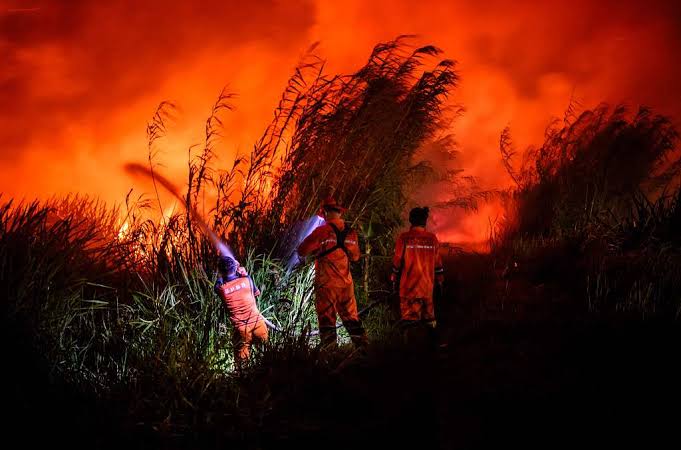
Firefighters in eastern England have spent days battling a major fire at Holme Fen Nature Reserve in Cambridgeshire. Peatland fires like this one are becoming increasingly common around the world, and understanding why reveals a lot about how climate change is reshaping natural landscapes that were once considered relatively fire-resistant.
What Peatland Actually Is
Peatland is a type of wetland ecosystem formed over thousands of years through the slow accumulation of partially decomposed plant material. This organic material, known as peat, builds up gradually in waterlogged conditions that prevent full decomposition.
Peatlands cover a relatively small percentage of the earth’s land surface, but they store an enormous amount of carbon, more than all the world’s forests combined, according to environmental researchers. This makes them one of the most important, and often overlooked, ecosystems for regulating global carbon levels.
Why Peatlands Were Historically Resistant to Fire
Under normal, healthy conditions, peatlands remain consistently waterlogged. This constant moisture makes them naturally resistant to fire, since the organic material simply does not dry out enough to ignite easily under typical conditions.
This natural fire resistance is part of what made peatland fires historically rare events, particularly in temperate regions like the United Kingdom, where Holme Fen is located.
What Changed
Climate change has altered this equation significantly. Rising temperatures and shifting precipitation patterns have led to drier conditions in many peatland regions, even those located in traditionally wet climates. When peatlands dry out, even partially, they become significantly more vulnerable to fire.
Drought conditions, extended dry spells, and reduced groundwater levels all contribute to this increased vulnerability. Once dried peat ignites, it behaves very differently from a typical surface fire.
Why Peatland Fires Are Particularly Difficult to Fight
Unlike typical wildfires that burn primarily across the surface, peatland fires can burn underground, smoldering slowly through layers of dried organic material. This makes them notoriously difficult to fully extinguish, since visible surface flames may appear controlled while the fire continues spreading beneath the ground.
These underground fires can persist for weeks or even months, resurfacing unexpectedly in new locations as they slowly work their way through connected peat deposits. This is part of why firefighters battling the Holme Fen fire have faced such a prolonged and challenging response effort.
The Carbon Release Problem
Because peatlands store such enormous amounts of carbon, burning peat releases significant quantities of carbon dioxide into the atmosphere, carbon that had been safely locked away for potentially thousands of years. This creates a troubling feedback loop: climate change contributes to drier peatlands, drier peatlands become more vulnerable to fire, and peatland fires release stored carbon that further contributes to climate change.
Environmental researchers have increasingly flagged this feedback loop as a significant concern, since it means peatland fires do not just represent immediate ecological damage. They actively contribute to the broader climate conditions that made the fire more likely in the first place.
Where Else This Is Happening
The United Kingdom is far from alone in facing increased peatland fire risk. Similar patterns have been observed in peatland regions across Southeast Asia, particularly Indonesia, where large-scale peatland fires have become a recurring seasonal concern, often linked to both climate conditions and land management practices.
Russia, Canada, and parts of Northern Europe have also seen increased peatland fire activity in recent years, reflecting a broader global pattern rather than an isolated regional issue.
The Ecological Impact Beyond Carbon Release
Beyond their climate implications, peatland fires cause significant direct ecological damage. These ecosystems support unique plant and animal species adapted specifically to peatland conditions, many of which struggle to recover quickly after a major fire event.
Restoration of damaged peatland can take decades, given how slowly these ecosystems naturally regenerate. This makes prevention significantly more valuable than recovery efforts after a fire has already occurred.
What Firefighting Teams Are Dealing With at Holme Fen
The ongoing response at Holme Fen reflects the broader challenges associated with peatland fires generally. Firefighters must contend not just with visible flames, but with the risk of underground smoldering that can persist even after surface fires appear contained.
This requires sustained monitoring and repeated intervention over an extended period, rather than the more straightforward containment approach typically used for standard surface wildfires.
What Can Be Done to Prevent Future Peatland Fires
Environmental researchers point to several strategies for reducing peatland fire risk going forward. Rewetting degraded peatlands, restoring natural water levels through targeted conservation efforts, can help rebuild the natural fire resistance these ecosystems once had.
Improved early detection systems, capable of identifying underground smoldering before it spreads extensively, also represent an important area of ongoing research and investment for regions with significant peatland coverage.
Why This Matters Globally, Including for Africa
While peatland fires are more commonly associated with regions like the United Kingdom or Southeast Asia, Africa does contain significant peatland deposits, including large reserves in the Congo Basin. As climate change continues to alter precipitation and temperature patterns globally, understanding the risks associated with peatland fires becomes relevant well beyond the regions currently experiencing them most visibly.
The Bottom Line
The fire at Holme Fen Nature Reserve is part of a broader, troubling global pattern. As climate change continues to dry out peatland ecosystems once considered naturally fire-resistant, these events are likely to become more frequent, not less.
Understanding why these fires happen, and why they are so difficult to fully extinguish, highlights a broader truth about climate change. It does not just create new risks. It transforms previously stable ecosystems into vulnerable ones, with consequences that extend far beyond the immediate fire itself.