

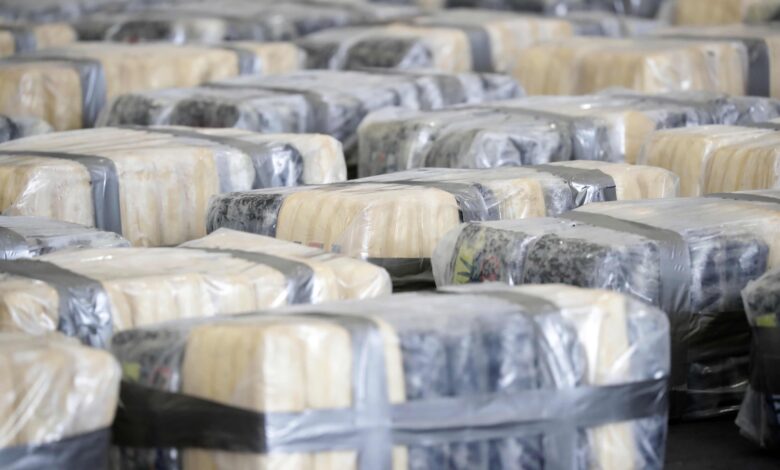
Start with what is not in dispute. According to the Minority’s own public statement, reported by 3News, high-profile narcotics seizures linked to Ghana now total “well over US$1 billion in under two years” under the current administration.
That figure combines several specific, named incidents: the Pedu Junction seizure valued at over US$350 million, a roughly US$150 million seizure of 120 cocaine slabs along the Takoradi-Cape Coast highway, a June 18, 2026 Australian customs seizure of methamphetamine valued at about US$261 million concealed in charcoal traced to Ghana, and the September 10 Dunkirk seizure of 3.9 tonnes of cocaine valued at over US$260 million.
These are not Minority allegations about amounts. They are figures drawn from actual seizures by actual foreign customs authorities, in France, Australia, and domestically.
Whatever one thinks of the Minority’s political motives in raising them together, the underlying seizures themselves are independently documented events.
Where the Two Sides Actually Diverge
The genuine dispute is not about whether Ghana has a cocaine transit problem. It is about accountability for who enables it.
Minority Leader Haruna Iddrisu framed the core demand directly, according to MyJoyOnline‘s reporting: “This is becoming one too many that has actually necessitated us calling for this emergency recall. This is the biggest cocaine bust in the history of this country, that 3.9 tons of cocaine had been intercepted, allegedly coming from Ghana.”
The Majority’s response, through Deputy Majority Whip Richard Acheampong, does not dispute the seizures. It disputes the Minority’s standing to investigate them, according to MyJoyOnline: “The government has taken steps to deal with all these matters.
A meeting has been convened.” This is a process objection, not a substantive one — it says the Minority lacks capacity to run an inquiry, not that an inquiry is unwarranted.
My Own View: Both Sides Are Arguing About the Wrong Thing
Here is where I will state my own position plainly, as this is an opinion piece. The fight over whether Parliament should be formally recalled, and whether the Minority has the “capacity” to investigate, is largely beside the point.
The actual, substantive pattern worth Ghana’s attention is the one the Minority itself identified, almost in passing, in its own statement: that “couriers, drivers, mates, and freight-forwarding agents” keep getting prosecuted while the people who actually own and finance these shipments do not.
This is not a partisan talking point. It is a pattern visible in the court record itself. In the Kwabenya Circuit Court case over the separate 3.9-tonne shipment, the six people denied bail are named as Francis Narh Amanor, Frank Adu-Boahen, Togbe Agbeti, Andrews Tetteh Amponsah, Daniel Laryea and Helena Akua Denkyi, according to MyJoyOnline — with a big man alleged to be the owner of the containers, arrested at what prosecutors describe as a hideout.
In the earlier Pedu Junction case, the Minority itself notes only “the driver, a housemaid and a few other suspects” have been arraigned, more than a year on.
Why This Framing Matters More Than the Recall Fight
If Parliament spends its energy litigating whether an emergency recall is procedurally justified, rather than directly examining why Ghana’s prosecution record on these specific cases consistently stops at drivers and couriers.
The country risks having an intense political moment that produces a debate about Parliament’s own procedures rather than a genuine accounting of its ports and enforcement gaps.
This is not a hypothetical concern. Lawyer and IMANI Africa Vice President Kofi Bentil made a version of this exact point publicly, according to MyJoyOnline, calling for the arrest of “everyone” in the handling chain of the Dunkirk-linked container — a demand aimed squarely at the gap between who gets charged and who actually profits.
What a More Useful Parliamentary Response Would Look Like
A more productive path, in my view, would set aside the recall-versus-capacity argument entirely and focus narrowly on two questions neither side’s public statements have yet answered directly.
Why container inspection and port intelligence systems have not identified financiers in any of these specific, named cases, and whether Ghana’s prosecutorial approach to drug cases structurally tends to stop at the person physically caught with the goods rather than tracing ownership and financing upward.
Those are investigable, answerable questions regardless of whether the specific mechanism is a formal parliamentary recall, a standing committee inquiry, or the inter-agency task force the government has already pointed to.
The Minority itself has separately argued, according to MyJoyOnline, that this existing task force “cannot replace a parliamentary inquiry” — a fair point, but one that still sidesteps the actual substantive question of why financiers keep evading prosecution regardless of which body investigates.
A Reasonable Caveat
None of this is to say the Minority’s motives are purely good-faith accountability-seeking, or that the Majority’s procedural objections are purely obstructive.
Ghanaian politics, like most, mixes genuine public interest concern with partisan positioning on both sides of an exchange like this one. Readers should weigh both sides’ statements with that in mind.
The Bottom Line
Ghana genuinely has reason for concern here: over a billion dollars in seizures tied to the country in under two years is a serious, well-documented pattern. Not a partisan exaggeration.
But the live political fight over whether Parliament gets formally recalled risks consuming the public’s attention while the more basic, structural question, why enforcement consistently catches couriers and not financiers, goes unanswered regardless of which procedural path Parliament ultimately takes.