I cry for this government and members for their future – Mireku Duker

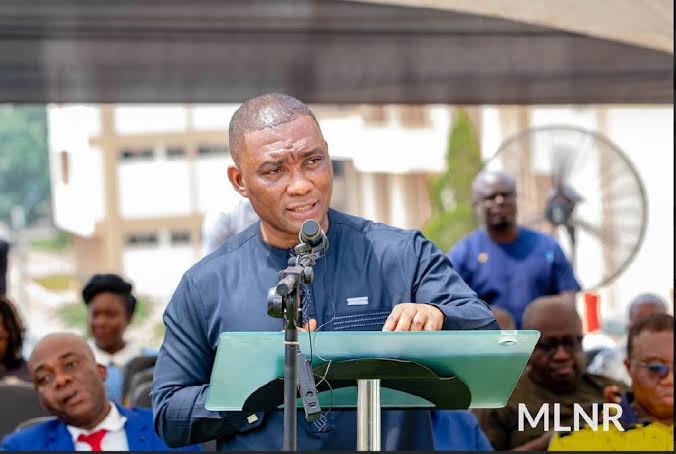
Former Deputy Minister for Lands and Natural Resources, George Mireku Duker, has expressed concern about the future of government appointees following the 20-year prison sentence handed to New Patriotic Party (NPP) Ashanti Regional Chairman Bernard Antwi Boasiako, popularly known as Chairman Wontumi.
Mireku Duker said the case should serve as a warning to people who currently hold political and government positions.
He believes government appointees must be careful about how they carry out their duties because they could face serious legal consequences if they are accused of wrongdoing.
His comments came after Chairman Wontumi was sentenced to 20 years in prison with hard labour by an Accra High Court.
Wontumi Sentenced to 20 Years in Prison
Chairman Wontumi was sentenced after he was found guilty of illegally permitting unlicensed mining operations on his company’s mining concession at Samreboi in the Western Region.
The case involved Wontumi and his company, Akonta Mining Company Limited.
The court found the company and Wontumi guilty on all counts brought against them.
Justice Audrey Kocuvie-Tay, who presided over Criminal Court 4, delivered the judgement on Monday, July 20, 2026.
Wontumi’s co-director, Kwame Antwi, was also involved in the case but remains at large. He was tried in absentia, meaning the case against him continued even though he was not present in court.
The court’s decision has generated discussions across the country, particularly among political parties and members of the public.
Mireku Duker Says Appointees Must Be Careful
Speaking about the judgement on Peace FM’s morning programme, Kokrokoo, Mireku Duker said the case should make government appointees think carefully about their actions.
He expressed sadness about what happened to Wontumi and said he was worried that other people working in government could face similar situations in the future.
“We need to be careful in how we are doing our things…I cry for those who have been employed in this government for their future. I am sad for them because if it’s Wontumi today, tomorrow it can be them,” he said.
Mireku Duker’s comments suggest that he believes people in government positions should be extra careful when carrying out their responsibilities.
He said the case involving Wontumi should not be seen as an isolated incident.
Instead, he believes it should remind all government appointees that they may also face legal challenges if they are accused of breaking the law.
Concern Over Circumstantial Evidence
One of the main issues raised by Mireku Duker was the use of circumstantial evidence in criminal cases.
Circumstantial evidence refers to information that does not directly prove that someone committed an offence but may be used to connect a person to the alleged crime.
Mireku Duker warned that if a person can be convicted based on circumstantial evidence, other people in similar situations could also face the same possibility.
He said government appointees should therefore understand that they are not automatically protected from legal action because of their positions.
“If someone can be jailed based on circumstantial evidence, know that it can happen to you too. I hope the Court of Appeal will interpret this and prove to us that this is what the law says on the matter of being proven beyond reasonable doubt,” he added.
His statement shows that he wants the Court of Appeal to provide more clarity on how the law should be applied in cases where circumstantial evidence is used.
Call for Legal Clarity
Mireku Duker also expressed hope that the Court of Appeal would examine the case and provide a clear interpretation of the law.
He specifically referred to the legal principle that an accused person must be proven guilty beyond reasonable doubt before a criminal conviction can be made.
This principle is an important part of criminal justice. It means that the evidence presented in court must be strong enough to convince the court that the accused person committed the offence.
Mireku Duker appears to be calling for the appellate court to clarify how this principle applies when the main evidence in a case is circumstantial.
His comments come at a time when Wontumi’s conviction and sentence have become a major topic of public discussion.
Wontumi’s Case Raises Political Concerns
The sentencing of Wontumi has attracted attention because of his position as a leading member of the NPP.
As the Ashanti Regional Chairman of the party, he is a well-known political figure and has played an important role within the party.
His conviction has therefore caused concern among some of his political colleagues and supporters.
Mireku Duker’s comments show that the case has also raised questions about the risks faced by people who hold public and political positions.
According to him, the case should encourage government appointees to be more careful in their work and understand that their decisions could have serious consequences.
The Case May Continue Through the Appeals Process
Although Wontumi has been convicted and sentenced by the High Court, the legal process may not necessarily end there.
Mireku Duker has expressed hope that the Court of Appeal will examine the issues raised by the case.
The appeal process could provide another opportunity for the legal arguments and evidence to be reviewed.
The former deputy minister’s comments suggest that he is particularly interested in how the higher court will deal with the question of circumstantial evidence and the requirement to prove a person’s guilt beyond reasonable doubt.
A Warning to Those in Government
For Mireku Duker, the most important lesson from the case is that people working in government must be careful.
Government appointees often make decisions that affect public resources, businesses and national policies. Their actions can therefore come under public and legal scrutiny.
Mireku Duker believes that what happened to Wontumi should remind others to understand the possible consequences of their actions.
His warning is not only about the current government but also about anyone who may hold a public position in the future.
He is concerned that a person who is in government today could face legal problems tomorrow if questions are raised about decisions made while in office.
Final Thoughts
George Mireku Duker has expressed concern for government appointees following the 20-year prison sentence handed to Chairman Wontumi.
He believes the case should serve as a warning to people in government and political positions to be careful about their actions and decisions.
Mireku Duker also raised concerns about the use of circumstantial evidence and called on the Court of Appeal to provide clarity on how the law should be applied.
He stressed that if someone can be convicted based on circumstantial evidence, others could potentially face similar situations.
The case involving Wontumi has therefore become more than just a legal matter. It has also sparked wider discussions about the responsibilities of government appointees, the need for people in public positions to act carefully and the importance of ensuring that criminal cases meet the required legal standard of proof.
As the legal process continues, attention will remain on the case and any further action that may be taken through the appeals process.