
Ghana government accepts proposal to extend presidential term to 5 years and 35 years limit

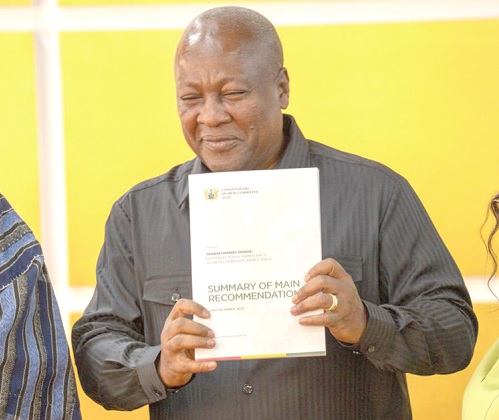
The government has accepted a recommendation to extend the term of office for Ghana’s President from four years to five years.
Under the proposed change, the term of Parliament would also be extended from four years to five years so that both presidential and parliamentary elections can follow the same cycle.
Attorney-General and Minister for Justice, Dr Dominic Ayine, announced the government’s position on Thursday, July 30, 2026, during a press conference at the Presidency.
The announcement came shortly after the Constitutional Review Committee presented its final report to President John Dramani Mahama at Jubilee House.
Government Explains Five-Year Term Proposal
Presenting the government’s White Paper on the recommendations made by the Constitutional Review Committee, Dr Ayine said the government had accepted the proposal to increase the presidential term from four years to five years.
He explained that the proposed change would give governments more time to plan, carry out and assess their policies before going back to the people for another election.
“The government has accepted a recommendation to extend the term of office of the president from four years to five years, with the term of Parliament extended to correspond with this,” he announced.
According to the Attorney-General, the current four-year term does not give governments enough time to fully carry out their plans.
He said the beginning of a government’s time in office is often taken up by the transition from one administration to another, while the final year is usually focused heavily on preparations for elections.
“Our thinking is practical. Under the current four-year cycle, the early months of every administration are consumed by transition matters, and the final year is largely consumed by elections,” he said.
“A five-year term provides a more realistic time frame for the formulation, implementation and assessment of government policy.”
The proposal, if eventually approved through the required constitutional process, would mean that future governments could have an additional year to implement their programmes and policies before facing voters again.
Government Proposes 35-Year Minimum Age for President
Dr Ayine also announced that the government had accepted, in principle, a recommendation to reduce the minimum age required for someone to become President of Ghana.
However, the government has proposed that the minimum age should be 35 years instead of the 30 years recommended by the Constitutional Review Committee.
“The minimum age will be 35 years, not 30 years,” he said, explaining that the proposed age would create more opportunities for younger Ghanaians while also ensuring that presidential candidates have enough maturity and experience.
The Attorney-General said the proposed age of 35 years reflects changes taking place in modern democratic countries, where more young people are being given opportunities to participate in leadership.
“Thirty-five is consistent with the trend in modern democratic constitutions towards greater inclusivity of the youth whilst ensuring that a candidate for the highest office has attained a measure of maturity and experience.”
The proposal could open the door for more young Ghanaians to consider running for the highest office in the country, while maintaining an age requirement that the government believes provides a balance between youth participation and experience.
Presidential Elections Could Be Held in November
The government has also accepted a recommendation to hold presidential elections during the first week of November.
However, the exact date would be decided by the Electoral Commission through a constitutional instrument.
Dr Ayine said fixing the period for presidential elections would make Ghana’s electoral calendar more predictable.
“A fixed period gives certainty to the electoral calendar. It allows the commission, the parties and observers to plan, and it ensures an adequate interval between the election and the inauguration of the incoming president on January 7.”
The proposed change is expected to give political parties, election observers and the Electoral Commission more time to prepare for elections.
It would also create a clear period between the announcement of election results and the swearing-in of a new President on January 7.
Changes to Presidential Election Petitions
The government has also accepted recommendations aimed at speeding up the process for dealing with presidential election disputes.
Under the proposed reforms, presidential election petitions would have to be filed within 14 days after the declaration of election results.
The Supreme Court would then be required to determine the petition within 30 days.
The proposed changes are intended to ensure that disputes over presidential election results are resolved quickly and do not remain unresolved for long periods.
Electoral Commission to Provide Election Data
Another proposed reform would require the Electoral Commission to provide all relevant election data to the courts and parties involved in a presidential election petition.
Dr Ayine said the proposed requirement would help ensure that all sides in an election dispute have access to the information needed for the court to properly examine the case.
The government believes the reforms will help improve Ghana’s democratic system and make the process of resolving election disputes more efficient.
According to Dr Ayine, the proposed constitutional changes are part of efforts to strengthen democratic governance and ensure that election-related cases are handled within a reasonable period.
Constitutional Changes Still Require Further Steps
Although the government has accepted the recommendations, the proposed changes to the Constitution will still have to go through the necessary legal and constitutional procedures before they can take effect.
The proposed reforms cover several important areas, including the length of presidential and parliamentary terms, the minimum age for presidential candidates, the timing of presidential elections and the process for dealing with election petitions.
If approved through the required process, the changes could significantly affect how Ghana’s future elections are organised and how long elected governments remain in office.
The proposal to extend the presidential term from four years to five years is likely to attract public discussion, particularly because it would change the current electoral cycle.
The government, however, believes that a five-year term would give elected leaders more time to implement their policies and deliver on their promises before returning to the electorate.



2 Comments