

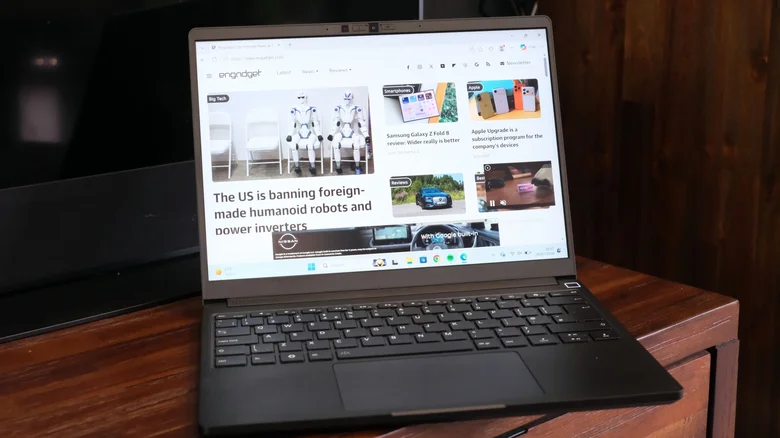
Framework has spent the past six years trying to prove that laptops can be built differently. Instead of making computers that are difficult to repair or upgrade, the company has focused on creating modular laptops that allow users to replace and improve parts over time.
That idea has helped Framework build a strong reputation among people who care about repairable technology. However, the company also knows that there is a limit to how far it can go if its laptops do not also match the quality of the biggest names in the computer industry.
Framework CEO Nirav Patel believes the company must make its laptops look better, feel better and perform better if it wants to compete with the best computers on the market.
“The benchmark for us is the MacBook Pro,” Patel told me back in April.
The new Framework Laptop 13 Pro is the company’s attempt to reach that goal. It is designed for people who use Windows or Linux and want a premium laptop without giving up the ability to repair and upgrade their computer.
After spending time with the laptop, the result is impressive. The Framework Laptop 13 Pro looks great, performs well and feels much more premium than earlier models. In fact, it can be considered one of the best Windows laptops available.
However, there is one major problem. The laptop arrived at a time when the price of computer memory has risen sharply. As a result, the cost of some versions of the Framework Laptop 13 Pro is now much higher than many buyers may be willing to pay.
A More Premium Design
From the moment the Framework Laptop 13 Pro is removed from its packaging, it feels like the company has put a lot of effort into improving the design.
Framework has kept the basic idea of the original Laptop 13, but it has made many small changes that give the new model a more polished appearance.
The new laptop has a machined aluminium body that feels stronger and more solid. The Graphite finish also gives the machine a more expensive look.
There are several other small design improvements. The old flat edges have been replaced with cleaner chamfered edges. The rubber feet are now rounded, while the Torx screws have improved heads that look more carefully made.
There is also no obvious gap between the keyboard area and the bottom part of the laptop. This makes the entire computer look as though it was made from one solid piece of metal.
The older Framework Laptop 13 was never an ugly computer, but its design was more focused on practicality than beauty. The new 13 Pro changes that.
With its better materials and improved finish, the Framework Laptop 13 Pro now looks much closer to premium laptops such as the ThinkPad and MacBook.
Framework Keeps Its Repairable Design
One of Framework’s biggest selling points has always been repairability.
The company wants people to be able to repair and upgrade their laptops instead of throwing them away when something breaks or becomes outdated.
The new Laptop 13 Pro continues that approach.
Framework has made it possible to use many components across different generations of its laptops. For example, it is possible to take a Framework Laptop 13 from 2021 and install the mainboard from the 2026 Laptop 13 Pro.
There are some limitations, however.
Some components may need to be replaced together because of compatibility issues. For example, someone changing from an Intel mainboard to an AMD mainboard may also need to replace the Wi-Fi module.
The new Laptop 13 Pro also comes with a larger 74Wh battery. Because the new battery is physically bigger, the laptop’s bottom cover has been redesigned.
This means that anyone upgrading an older Framework laptop to the larger battery may need to buy a new bottom cover and a new type cover as well.
Even with these limitations, the ability to upgrade major components remains one of the biggest advantages of the Framework system.
Better Keyboard and New Haptic Touchpad
The Framework Laptop 13 Pro uses the company’s familiar 1.5mm chiclet keyboard.
However, the keyboard feels slightly better than earlier versions. The keys have a satisfying feel when pressed and make typing comfortable.
The biggest improvement is the new haptic touchpad.
Framework has spent a lot of time improving the touchpad because the company wanted to create a Windows and Linux laptop that could compete with the excellent touchpads found on MacBooks.
The result is impressive. The haptic touchpad feels smooth and responsive and gives the Laptop 13 Pro a more premium experience.
Four Customisable Expansion Ports
Framework continues to use its modular expansion card system.
The laptop has four expansion card slots, allowing users to choose which ports they want to use.
Users can add different types of connections depending on their needs. The Intel version also supports Thunderbolt 4 across all four ports.
The new model also improves the system used to lock and remove expansion cards. The new mechanism is easier to use and feels like a small but useful improvement over previous Framework laptops.
A Sharp Touchscreen Display
Framework has also added a 13.5-inch touchscreen display with a resolution of 2,880 x 1,920.
The screen looks sharp and handles reflections very well. Even when used outside in bright sunlight, the display remains easy to see.
The touchscreen itself works well, although its usefulness may depend on the user. Since the laptop does not have a 360-degree hinge, the screen cannot fold all the way around like a traditional 2-in-1 computer.
Still, people who enjoy touching their laptop screen will appreciate having the option.
New RAM Makes Upgrades Easier
The Intel version of the Framework Laptop 13 Pro uses Intel’s new Panther Lake processors and LPCAMM2 memory.
LPCAMM2 is a newer type of laptop memory that can be removed and replaced. This is important because many modern laptops have RAM permanently attached to the motherboard.
With the Framework Laptop 13 Pro, users can upgrade the RAM later instead of replacing the entire laptop.
The downside is that LPCAMM2 memory is still relatively new and has become very expensive. This has had a major effect on the price of the new laptop.
Excellent Everyday Performance
The Laptop 13 Pro tested was a mid-range model with an Intel Core Ultra X7 358H processor, Intel Arc B390 graphics, 32GB of LPCAMM2 RAM and a 1TB SSD.
Under normal circumstances, this kind of hardware would make the laptop a powerful option for work and everyday use.
The laptop handles normal tasks with ease. Multitasking, web browsing, writing and other productivity work all run smoothly.
The laptop can also handle more demanding tasks.
Even when running a small local AI model, the computer remained relatively quiet. The fans became louder during demanding tasks, but they did not become distracting.
The laptop was also able to run Cyberpunk 2077 at its default settings. While it is not designed as a gaming laptop, the performance was still good enough for some gaming.
Framework Finally Fixes Its Cooling Problem
One of Framework’s biggest weaknesses in the past has been cooling.
Because the company builds its laptops around modular mainboards, the cooling system has to work within a design that is different from that of traditional laptops.
Older Framework laptops could become very loud when placed under heavy workloads.
The Laptop 13 Pro appears to solve much of that problem.
Framework worked with Intel to improve the cooling system, while the new Panther Lake processors also appear to be more efficient.
During normal use, the laptop is almost silent.
Even in a warm room, the fans rarely became noticeable during everyday tasks. This is a major improvement over some previous Framework models.
The fans only became very loud during the most demanding activities, such as gaming.
Battery Life Is Much Better
Framework laptops have also faced criticism over battery life in the past.
The Laptop 13 Pro attempts to address that issue with its larger 74Wh battery.
Framework claimed the laptop could stream 4K Netflix for 20 hours and provide up to 17 hours of active web browsing.
In a standard battery test, the Laptop 13 Pro lasted 16 hours and five minutes.
That is not the longest battery life among all laptops using the same processor family, but it is still enough for a full day of normal work for many users.
The bigger advantage is that the battery can be replaced.
When the battery in a traditional laptop eventually fails, many people may have to replace the entire computer. With the Framework Laptop 13 Pro, users can simply install a new battery.
That makes the laptop more useful over the long term.
The Biggest Problem Is the Price
The biggest concern with the Framework Laptop 13 Pro is currently its price.
The cost of laptop components, especially RAM, has increased significantly.
At the time of the review, the version with a Core Ultra 5 325 processor, 16GB of RAM and a 512GB SSD cost $1,600. The price increased to $1,800 with Windows 11.
The more powerful model tested, with a Core Ultra 7 358H processor, 32GB of RAM and a 1TB SSD, costs around $3,100.
That is a huge amount of money for a 13-inch laptop.
Framework explained that its supplier increased the price of LPCAMM2 RAM dramatically. The company said it could not absorb the full increase without putting its own business at risk.
Framework’s willingness to explain the situation openly is a positive sign. The company has been clear about why prices changed instead of hiding the problem from customers.
Final Verdict
If someone needed to buy a new Windows laptop today, the Framework Laptop 13 Pro would be a very strong choice.
It has a beautiful design, excellent performance, a great keyboard and one of the best haptic touchpads available on a Windows or Linux laptop.
The improved cooling system is another major achievement. The laptop runs quietly during everyday use, while the larger battery provides strong battery life.
Most importantly, Framework has not abandoned the idea that made its laptops special.
The Laptop 13 Pro is still designed to be repaired and upgraded. If the battery fails years from now, users can replace the battery. If they need more memory, they can upgrade the RAM. If the mainboard becomes outdated, they can replace it.
That makes the Framework Laptop 13 Pro different from many modern laptops that are difficult or impossible to repair.
Laptop 13 Pro different
There are still some weaknesses. The speakers could be better, and the webcam does not match the quality found on some competing premium laptops. The laptop is also not the thinnest option available.
The biggest reason to wait before buying is the price. The current high cost of RAM has pushed the Laptop 13 Pro into a price range that may be difficult to justify.
If prices return to normal, the Framework Laptop 13 Pro could become one of the most attractive laptops for people who want premium performance without giving up the freedom to repair and upgrade their own computer.
For now, the Framework Laptop 13 Pro shows that a repairable laptop does not have to feel like a compromise. It can be powerful, quiet, attractive and enjoyable to use while still giving owners control over what happens to their machine years after they buy it.