


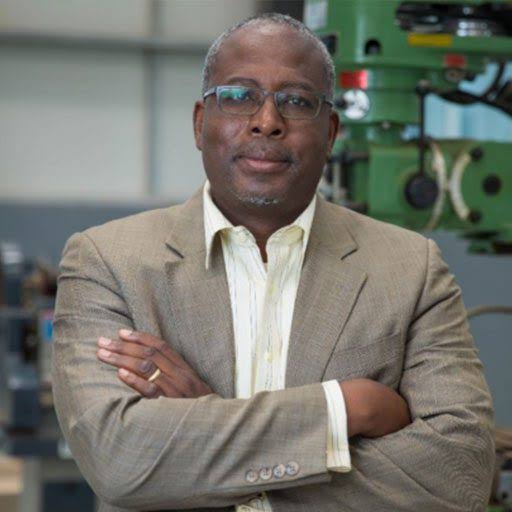
Professor Fred McBagonluri, President of Academic City University, Speaking in an interview on JoyNews, the academic and engineer explained that his belief in practical engineering education grew from both his professional experience abroad and what he saw after returning to Ghana.
For him, engineering education should not stop at passing examinations.
Students should be able to program, model, design, build and turn their ideas into useful products and businesses.
What Changed Professor McBagonluri’s Thinking?
Professor McBagonluri said his thinking about engineering education began during his time working in the United States.
He recalled hiring a graduate from one of Ghana’s universities while working there.
The graduate later told him that one of his biggest challenges when he entered graduate school in the United States was that he could not program or model well enough.
In a typical American master’s or PhD classroom, Professor McBagonluri explained, the lecturer does not necessarily care which university a student attended.
“The assumption is that everybody is at the same level. And he wasn’t, and he struggled.”
That experience made him ask an important question about how Ghana trains its graduates.
“And so, that really was my the beginning of my journey into academia. How can we educate differently?”
For McBagonluri, the experience highlighted the difference between earning a qualification and developing the practical skills needed to compete in demanding engineering environments.
Seeing Ghana’s Problems Through an Engineer’s Eyes
His thinking became even stronger after returning to Ghana.
Professor McBagonluri said travelling through the Volta Region made him question why Ghana was struggling with problems that engineers in other parts of the world were finding ways to manage.
He described seeing the sea gradually taking away land and affecting communities along the coast.
“And in many parts of the world where I have worked at, they actually harness land from the sea.”
That experience raised a question for him.
“So, why is the sea chasing us away when we can actually tame it?”
His argument is that Ghana should not simply accept difficult environmental and infrastructure problems as permanent.
Instead, engineers should be trained to study the problem, develop solutions and build systems that can work within Ghana’s economic and environmental conditions.
From Construction Waste to Reusable Materials
Professor McBagonluri also pointed to Ghana’s construction industry.
He said driving through a typical construction site often exposes a familiar sound.
“And then you drive through a typical construction site and all you hear is ba ba ba ba. And I’m thinking it should be tr tr tr so that you can reuse the material that you’re using for construction.”
His comments point to the potential for engineering methods that allow construction materials to be reused instead of being treated as waste.
For him, this is what practical engineering should look like.
Engineers should not simply follow traditional methods because they have always been used.
They should ask whether there is a better, cheaper and more sustainable way to do the job.
Ghana’s Roads Are Another Example
Road construction was another area Professor McBagonluri highlighted.
He described some Ghanaian roads as “quick prey roads”, referring to roads that deteriorate shortly after construction.
“We sprinkle chippings on the roads and in in a few weeks before the construction ends, the roads are gone.”
His concern is not simply about road maintenance.
He believes Ghana needs to apply engineering methods that recognise the country’s limited resources while still producing stronger and more durable infrastructure.
“And how can we really apply real engineering to make sure that in a resource constrained environment, you build in a robust manner.”
This is an important point because Ghana cannot always solve infrastructure problems by simply spending more money.
The country also needs to find ways to make every cedi invested in infrastructure produce better and longer-lasting results.
“No, Not Yet”: His View of Engineering in Ghana
The JoyNews host asked Professor McBagonluri whether his use of the phrase “real engineering” suggested that he did not see real engineering being practised in Ghana.
His answer was measured. “No, not yet. I think the talent is there.”
He said Ghana has talented people who can become excellent engineers.
The challenge, in his view, is how that talent is developed and given the opportunity to solve real problems.
This is one reason engineering is among Academic City’s areas of focus.
He also places engineering alongside entrepreneurship because he believes students should not only develop technical solutions but should learn how to turn those solutions into products and businesses.
Academic City Takes a Hands-On Approach
Professor McBagonluri said Academic City places strong emphasis on practical learning.
“Academic City is very hands-on. You will do projects. We encourage you to do internships. We encourage you to build.”
The approach is designed to move students beyond classroom theory.
Instead of simply learning how something works from a textbook, students are encouraged to build and test things themselves.
McBagonluri said this approach is also personal for him because he enjoys building things.
“I like to build things.”
He gave an example from his own home.
“I just finished a project in my house where I harness free rainwater with solar.”
The project connects directly to another major problem Ghana faces: flooding.
Could Rainwater Harvesting Help Reduce Flooding?
Professor McBagonluri believes Ghana could make better use of rainwater instead of allowing large amounts of water to run off into already stressed drainage systems.
He connected his rainwater harvesting project to the country’s recurring flood problems.
“And that also speaks to the floods we have. If we can harness much of this water that is falling freely, will we continue to have floods at the level that we have them today?”
The question reflects the type of thinking he wants students to develop.
Rather than looking at rain only as a problem, engineers can also consider it a resource.
Rainwater can potentially be captured, stored and used for appropriate purposes.
Such systems could also reduce the amount of water entering drainage systems during heavy rainfall, although they would need to be properly designed and would not by themselves solve Ghana’s wider flooding problems.
Students Must Build, Not Just Study
One of Professor McBagonluri’s strongest messages is that university projects should lead to real-world solutions.
He said Academic City encourages students to take the things they build beyond the classroom.
“We encourage the students to actually build products and to take those products into entrepreneurship, not just to leave them on shelves.”
That distinction is important. A student can complete a project, receive a grade and move on.
But if that project solves a real problem, it could potentially become a business, create jobs and serve communities.
That is the connection Professor McBagonluri wants between education and entrepreneurship.
Projects Are at the Centre of the Learning Model
According to Professor McBagonluri, every Academic City student is expected to complete a final project.
But students can also participate in projects across the university and projects linked to individual courses.
The university also tries to connect projects across different subjects.
This means students may work on one larger project instead of completing several unrelated projects for different courses.
Professor McBagonluri said this approach allows students from different areas to bring their skills together.
Engineering Problems Need More Than One Skill
He began giving an example involving students studying embedded systems and mechanical design.
The idea is to create connections between different courses so students can work together on a unified problem.
This reflects how engineering works outside the classroom.
A real product rarely requires only one skill. For example, developing a smart machine may require mechanical engineering, electronics, computer programming, data analysis and business knowledge.
A university that brings those areas together can give students a better understanding of how real engineering projects are developed.
Why Practical Engineering Matters to Ghana
Ghana faces many problems that require technical solutions. These include flooding, road deterioration, coastal erosion, waste management, energy challenges, water supply and industrial development.
Solving these problems requires more than importing technology from other countries.
Ghana also needs engineers who understand local conditions.
A solution that works in another country may not work exactly the same way in Ghana because of differences in climate, available materials, infrastructure, income levels and maintenance capacity.
That is why Professor McBagonluri’s argument about “resource constrained” engineering is important.
The goal is not necessarily to build the most expensive solution.
The goal is to build a solution that works, lasts and can be maintained. The Bigger Problem With Engineering Education
The interview raises a broader question about higher education in Ghana. Should universities primarily prepare students to pass examinations and earn degrees?
Or should they also prepare students to solve practical problems?
Professor McBagonluri clearly supports the second approach.
His experience with the Ghanaian graduate who struggled with programming and modelling showed him that academic qualifications do not always guarantee practical readiness.
For engineering graduates, skills such as computer modelling, programming, design, testing and problem-solving can be just as important as theoretical knowledge.
From Classroom Projects to Ghanaian Businesses
There is also an economic argument behind this approach.
Ghana needs more businesses that are built around technology, engineering and locally developed solutions.
University students can become an important source of those ideas.
A student who develops a low-cost water management system, a more efficient farming machine or a technology-based construction solution could potentially turn that project into a business.
That could create employment while also addressing a local problem.
This is why Professor McBagonluri connects engineering with entrepreneurship.





2 Comments